How to Choose the Right Influencer for Your Niche Market
Find the right influencer for your niche market by aligning brand values, analyzing engagement metrics, and verifying authenticity to maximize campaign ROI.
Picking the right creator is the single biggest lever in any campaign — and in 2026 the rules have flipped. Audience fit and engagement now beat raw follower count, with roughly 73% of brands favouring micro and mid-tier creators over celebrity and macro accounts. The catch: about 37% of influencer followers are fake or inauthentic, so choosing well is as much about vetting as it is about discovery.
In this guide we walk through the factors that actually predict a successful partnership in 2026: defining your goals, matching audience over reach, choosing the right creator tier, vetting for fraud, and locking down cost and logistics. By the end you'll have a repeatable checklist for shortlisting creators who move revenue — not just vanity metrics.
Define your campaign goals and target audience
Decide what results your campaign aims to bring and how is going to achieve them, also consider narrowing down the audience you are interested in reaching.
Before choosing an influencer, you must have clear your campaign goals and target audience.
What do you want to achieve with your campaign? Do you want to increase brand awareness, drive sales, or promote a new product/service? Defining your campaign goals is always the first step to preparing a clear and effective campaign, even in influencer marketing.
Once you have defined your campaign goals, it’s essential to understand your target audience.
Who are they? What are their interests, values, and demographics?
Understanding your target audience will help you choose an influencer whose followers match your target audience. For example, if you’re targeting Gen Zers, you should partner with an influencer with a predominant Gen Z following.
Having clear your campaign goals and target audience will help choose the right influencer. Target audience is critical since each creator has a different audience. Recognizing whose creators have access to the audience you are looking for will be a game changer for any campaign. If you don’t know how to identify creators’ unique demographics, tools like CreatorDB can help you. With CreatorDB, you get access to each creator’s demographics, which allows you to search for specific criteria to find who fits your requests quickly.
Look for influencers who align with your brand values
The influencer you partner with should not only be related to your industry but also be compatible with your brand values and mission in order to create better and more fitting content.
Once you have defined your campaign goals and target audience, looking for influencers who align with your brand values is the next step. The influencers you choose will represent your brand, so the more your and their values overlap less this will look like only a commercial partnership.
Start by identifying influencers in your niche or industry. Look for influencers who have previously discussed your brand and share similar values. For example, if you’re a sustainable fashion brand, you may want to partner with an influencer passionate about sustainable living.
Being able to find influencers that align with your brand’s values is going to evolve into more genuine content. You will have to dive into each potential partner’s previous content to identify how they have engaged with similar topics or products and if they would fit your brand well.
CreatorDB and its content search allow you to do exactly that: set relevant hashtags as filters and let our database find all the pieces of content that mention them.
Once you individuated promising creators you can look them up in the main database to find if they are a true match.
Avoid influencers previously working for your direct competitors. However, individuating previous partnerships can take a lot of work to do manually. You can use the CreatorDB platform to individuate the sponsored content of each creator and know who they worked with.
Choosing an influencer who aligns with your brand values and can genuinely promote your product or service will help ensure their audience will resonate with your brand. It will also help you build a long-term relationship with the influencer, which can lead to future collaborations.
Analyze the influencer’s reach and engagement
Before partnering with an influencer, analyzing their reach and engagement on social media is essential. The influencer’s reach is the number of people who see their content, while their engagement is the number of people who interact with it, such as likes, comments, and shares.
To learn more about which metrics to look at, read our Analytics 101.
Reach and engagement are often negatively correlated: large influencers have higher reach due to their sizable following, but their content gets interactions from a small percentage of their followers. Smaller creators have limited reach but often have highly engaged audiences. The 2026 data makes the trade-off stark — micro-influencers average about 3.86% engagement against roughly 1.21% for mega accounts, and they deliver around 3.2x higher engagement at ~60% lower cost per post.
Match the creator tier to your goal
There is no single “best” tier — each trades reach for trust. Use this as a quick map when you build your shortlist:
Nano & Micro Highest engagement
Under ~100K followers. Tightest niche fit, the strongest engagement and conversion, and the best ROI — about $7.14 per $1. Ideal for community-led launches and performance campaigns.
Mid-tier Brand favourite
Roughly 100K–500K. The sweet spot ~73% of brands now lean into: meaningful reach while keeping cost and engagement balanced. Good for scaling a proven creator format.
Macro Broad reach
500K–1M. Wide exposure for awareness pushes, but engagement drops toward ~1.7% and cost per post climbs. Best paired with tight creative direction.
Mega / Celebrity Mass awareness
1M+. Maximum reach and prestige at the lowest engagement (~1.21%) and highest price. Reserve for tentpole moments, not everyday performance.
CreatorDB offers you an easy way to glance at all the creator’s platforms in the general section of each profile.
If you need a deeper look you can go to the tab for the specific platform and see it in more detail.
Vet authenticity and screen for fake followers
Influencer marketing builds on the idea of trust. Consumers trust influencers to provide them with honest opinions and recommendations. Therefore, when choosing the right influencer it is crucial to choose one that is authentic and credible in its audience’s eyes.
It is also crucial because fraud is rampant. A 2026 SociaVault study of 100,000 accounts found 37.2% of influencer followers show signs of being fake, purchased, or inauthentic, and 81% of senior marketers reported encountering influencer fraud in the past year. Before you commit budget, screen each shortlisted creator for the tell-tale signs: sudden follower spikes, an engagement rate far below the tier benchmarks above, low or generic comments, and an audience whose geography doesn’t match where the creator posts.
Research the influencer’s content to ensure it aligns with their brand and values. Look for influencers who are transparent about sponsored content and disclose their partnerships. This transparency builds trust with their audience and shows they are authentic and credible.
Choosing an authentic and credible influencer will help you build trust with their audience and, in turn, build trust with your audience. It will also ensure you partner with influencers who can give your brand a positive image and reputation.
Use CreatorDB’s free tools to discover and filter creators by niche, platform and engagement, then run any shortlist through the fake-follower checker before you spend a cent.
Browse & filter creators → Check creator engagement data →Consider the cost and logistics
Take into account rates for posts, expenses that you may incur if you want to ship them a product, and how distance and timeline affect the whole partnership.
Influencers can charge different rates for sponsored content, depending on their following, engagement rate, and type of content. When considering the cost, ensure that it aligns with your budget and that the partnership is worth the investment.
It’s also essential to consider the logistics of partnering with an influencer. Here are some simple questions to help you clarify:
- Will you provide the creators with promotional products?
- Will they create their content?
- What is the timeline for the campaign?
- How often will the influencer be posting?
Ensure you and the influencer are on the same page regarding logistics and expectations.
Lastly, ensure that you have a contract that outlines the partnership’s details, including compensation, deliverables, and timelines. This contract will protect you and the influencer and ensure both parties understand the expectations.
Consideration of the cost and logistics of partnering with an influencer will help ensure that the partnership runs smoothly and that the campaign is successful. It will also help you maximize your investment and ensure you get the most value from the partnership.
Conclusion
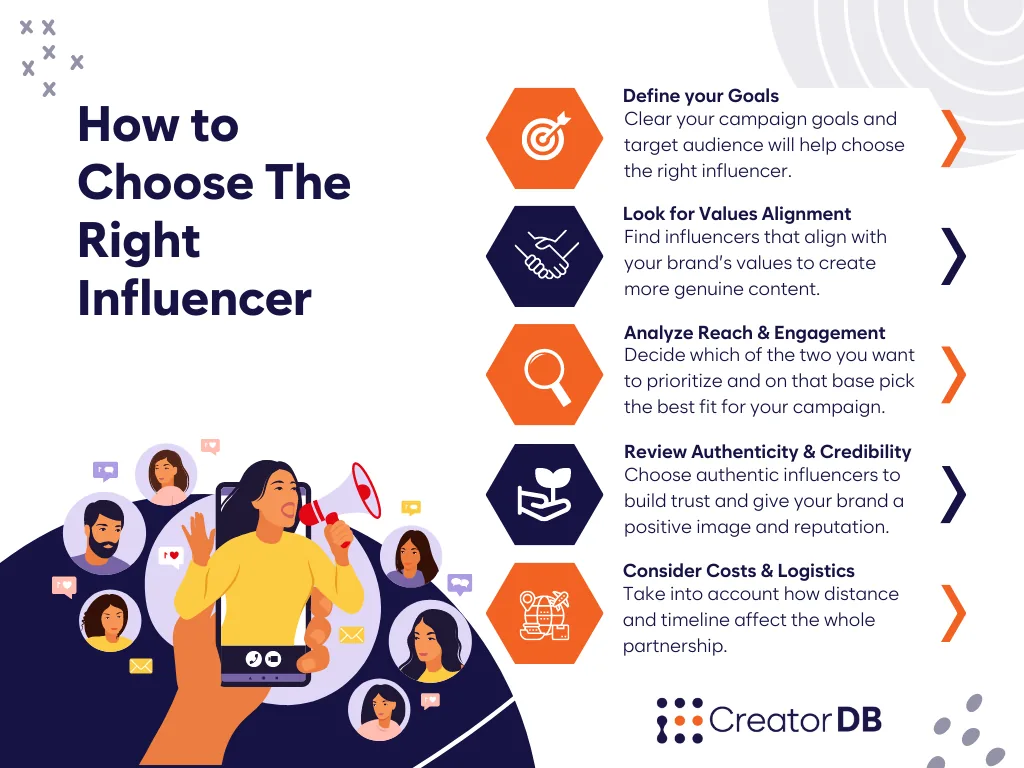
Choosing the right influencer for your next campaign can be challenging, but it’s essential for the success of your marketing efforts. By defining your campaign goals and target audience, looking for influencers who align with your brand values, analyzing their reach and engagement, determining their authenticity and credibility, and considering the cost and logistics, you can choose an influencer who will help you reach your marketing objectives effectively.
Remember that the success of your influencer marketing campaign is not solely based on the number of followers an influencer has but on the quality of their content and engagement with their audience. By following these steps, you can ensure that you partner with an influencer who is a good fit for your brand and can help you achieve your marketing goals.
Work with CreatorDB
Put this into
practice.
Talk to our Asia agency team about applying these ideas to a real creator campaign — or open the CreatorDB app and start building your shortlist now.
Frequently Asked Questions.
Does follower count still matter when choosing an influencer in 2026?
No — audience fit and engagement now beat raw reach. In 2026 nearly 73% of brands prefer micro and mid-tier creators over celebrity and macro accounts, because relevance and authenticity outperform follower count. Micro-influencers (10K–100K followers) average around 3.86% engagement versus roughly 1.21% for mega-influencers (1M+), and they deliver about $7.14 in ROI per dollar — the highest of any tier — compared with the $5.78 cross-tier average. A creator with 50k aligned followers is worth more than one with 500k misaligned followers.
How do you check if an influencer has fake followers?
Vetting is essential: a 2026 SociaVault study of 100,000 accounts found 37.2% of influencer followers show signs of being fake, purchased, or inauthentic, and 81% of senior marketers reported encountering influencer fraud in the past year. Check for sudden follower spikes, low or generic comments, an engagement rate far below the tier benchmark, and mismatched audience geography. Run any shortlisted creator through an audience-quality tool such as CreatorDB's free fake-follower checker before you commit budget.
Why do micro-influencers often outperform bigger influencers?
Engagement and audience relevance matter more than reach. Micro-influencers (10K–100K followers) average roughly 3.86% engagement versus about 1.21% for mega-influencers, deliver around 3.2x higher engagement at roughly 60% lower cost per post, and lead all tiers on ROI at about $7.14 per dollar spent. Their niche audiences trust them, so targeted reach converts where broad, misaligned reach wastes budget.
How can you find influencers who genuinely align with your brand values?
Search for creators who already discuss topics tied to your mission — use hashtags, content themes, and past brand partnerships as filters rather than follower count. CreatorDB's content search lets you filter by relevant hashtags and surface creators genuinely engaged with your industry, then review their non-sponsored posts to confirm authentic alignment. Avoid creators who have recently promoted a direct competitor.
What's the fastest way to research an influencer's past brand partnerships?
Manual research through social media is time-consuming and incomplete. CreatorDB's platform tracks each creator's sponsorship history, showing which brands they've worked with and when. This reveals competitor conflicts, identifies repeat partnerships, and helps you spot creators who've already promoted similar products — all in seconds rather than hours.