Social Media Datasets for Influencer Marketing
Access social media datasets and APIs to find ideal influencers, analyze audience data, and launch data-driven campaigns that deliver measurable results in 2026.

Whether you are a data analyst interested in understanding the TikTok algorithm, a Marketing professional wanting to prepare an effective Influencer marketing campaign, or just curious about how your Facebook fan page is doing, you need a set of data to work with, or we could say a social media dataset.
There are multiple ways you can get your hands on such data, in this article, we will go through the most common ones.
Some basics about the data
On social media, everything turns into data.
Even scrolling through a post leaves a mark. Data are a blessing for us who work with audiences, so you may be looking for more data to make better decisions.
You should know basic analytics and why they are essential.
Once you are familiar with analytics, you may start deciding which one matters for your specific case.
Since social media turn everything into data, there are way too many data points to be considered at a time. Therefore is vital for you to select what matters for your specific case.
Which one is right for you? Database or dataset?
Before we delve into this, let’s make it clear about the definitions of these two words:
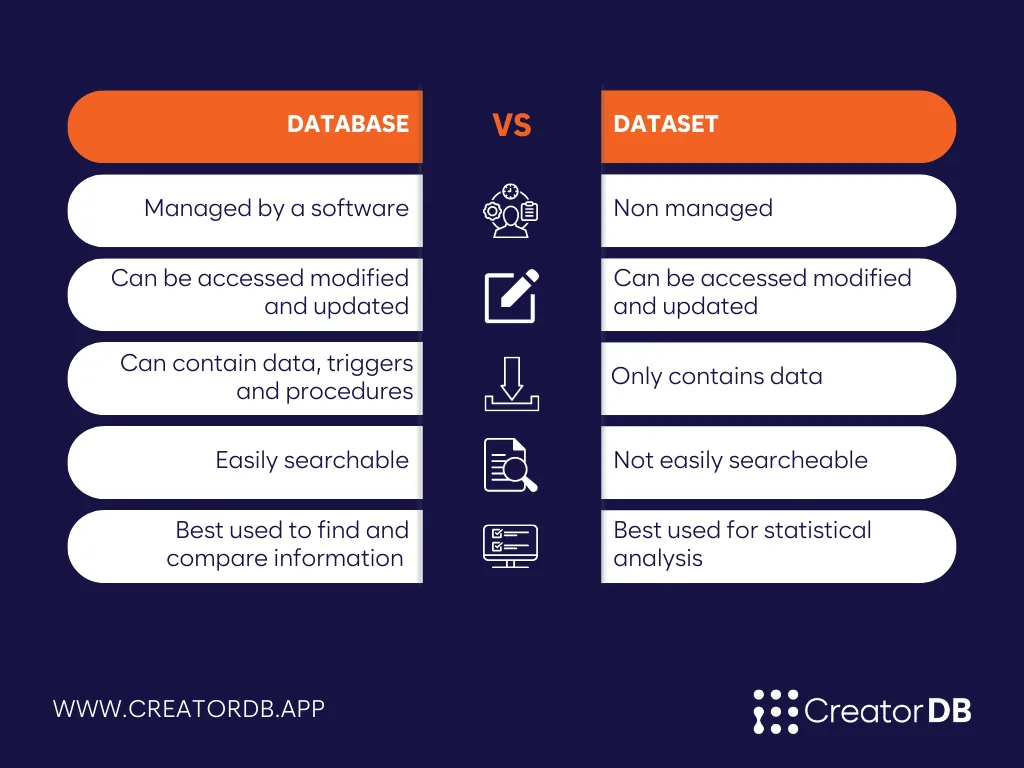
- A database is an organized collection of data managed by software that can be accessed, modified, and updated at any time. Other than pure data, there can be triggers and procedures saved in a database.
- A dataset is a collection of data arranged in columns and rows for statistical analysis.
This distinction is essential since if you are not into data analysis, you may prefer an already organized and searchable database to something you will have to figure out how to manage, as in the case of a dataset. If that’s the case using third-party software to obtain your data may be the best choice for you.
How to get your social media dataset?
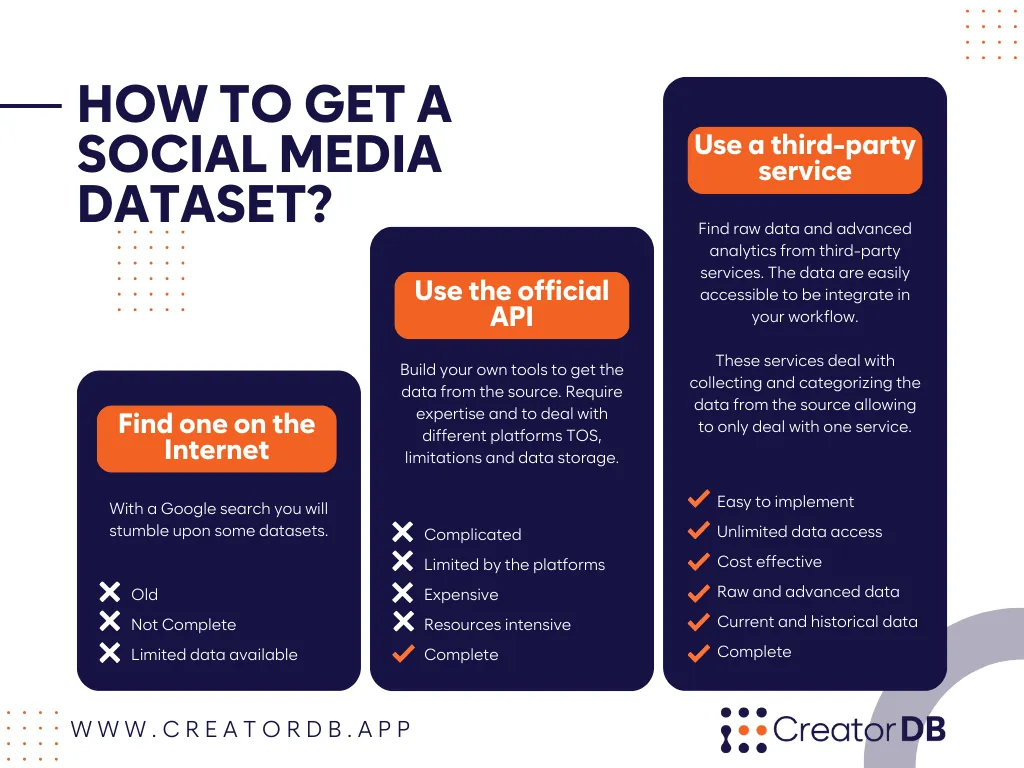
There are three main ways to obtain an influencer dataset:
- Search the already existing one on the Internet
- Obtain one from a third-party service (such as CreatorDB)
- Build your tools that apply the official APIs
1. Find an existing social media dataset on the Internet
This is the most straightforward and valid approach if you don’t particularly care about the freshness of the data or specific measures.
With a simple Google search for “influencer dataset,” you can come up with many results ready to be downloaded. But you don’t have to be too picky about what they are.
These datasets were compiled long ago and made public for anyone to use. Often they cover specific topics or groups of data. This solution may be perfect for you if you are a novice at data analysis and you are looking for something to practice with.
2. Use a third-party service to access their social media dataset
Services like CreatorDB constantly collect data from various social media and organize them for their users.
There you can find raw data collected from the source, for example, likes, views, and comments, but also more advanced calculations done by the service, like engagement rate, growth rates, and expected CPM.
These services will also organize the data in more intuitive and reliable ways since you will have to deal with only one service instead of several different social media, each with its way of dealing with data.
The availability of historical data is another factor to consider in this case since many third-party services offer data going further back in time than what you can obtain from the platforms themselves.
At CreatorDB, our database contains over 3 million influencers and is searchable for over 130 filters. Furthermore, we collect and organize data on the brands that engage in influence marketing and their campaigns.
The database is accessible through API and can integrate any system already in place. While we already perform many advanced analyses on the data, and they are immediately available to you, all results are exportable in Excel format, allowing for further study on your end.
We collect our data through industry-standard procedures that outperform social media official ways regarding how much data we can access and provide to our clients.
Third-party tools are the most flexible way for users to obtain an influencer dataset since they require little to no technical knowledge while still providing fresh data.
Especially for companies outsourcing the data collection may be the best option since it would not tie down internal resources to deal with many different platforms, data storage, and handling while allowing top-tier results in influencer marketing.
3. Use the official APIs to build a social media dataset
The most complicated and restricted solution but also the most advanced. You would have the ultimate freedom by creating your way of collecting social media data and storing and analyzing them. But with such liberty comes many problems you will have to deal with.
Each social media platform handles data differently, and you will have to understand each of them, their limits, and their blindspots to effectively and reliably obtain the data.
Social media companies often try to prevent actors from collecting data by implementing strict terms of service (TOS) about what data can be obtained and how they need to be treated, on top of that each service establishes quotas of data available to every API user defacto limiting what you can obtain through their API to a minimal amount.
If this sounds complicated, consider that you will have to deal with as many different TOSs as the platforms you are interested in. Furthermore, the platform’s approach to data distribution and API use is subject to changes, and each of such changes will require your operation to deal with it in order to keep collecting data.
Data storage and handling is the next thing you will have to consider. Social media are enormous and offer a lot of data points, making it very simple to accumulate impressive amounts of data; you will have to set aside TBs upon TBs just for data collection. Analyzing such large amounts of data also requires dedicated machines to work exclusively on the task.
These are other costs and resources you should consider when creating your system.
While the level of customization may be an attractive factor in deciding to build your own influencer dataset, most users would find it way too large and daunting of a task for their actual needs. In almost all scenarios, relying on professional data collection and analysis is recommended since it will result in more accessible and cheaper implementation.
On a final note
It is highly recommended to rely on third-party services regarding influencer marketing datasets and databases.
Using services like CreatorDB for your influencer marketing campaign can streamline your operations without tying up your company’s resources or funds. This is largely because these third-party providers handle all interactions with each social media platform, enabling you to benefit from comprehensive data without worrying about API restrictions or policy modifications.
Also, CreatorDB and similar services undertake advanced calculations and analyses on the data, leaving you to simply select the metrics relevant to your decision-making process.
Given these advantages, opting for third-party services should be a top consideration for your upcoming influencer marketing initiatives.
If you want to know more, contact us by filling out the form below. Let’s discuss your specific case and how we can tailor our offerings to your business needs.
Work with CreatorDB
Put this into
practice.
Talk to our Asia agency team about applying these ideas to a real creator campaign — or open the CreatorDB app and start building your shortlist now.
Frequently Asked Questions.
What's the difference between a database and a dataset for influencer marketing?
A database is an organized collection of data managed by software that you can access, modify, and update anytime—often with built-in search and procedures. A dataset is a static collection of data arranged in rows and columns for analysis. For influencer marketing, databases are better if you want live, searchable data; datasets suit practice or analysis work where freshness doesn't matter.
How do you get influencer data without building your own tools?
Three main routes exist: download existing public datasets online (best for learning), use a third-party service like CreatorDB (best for fresh, organized data with advanced metrics), or build custom tools using official APIs (most technical). Third-party services are fastest for brands since they handle multiple platforms, provide historical data, and require no internal technical resources to maintain.
What metrics should you track for an influencer marketing campaign?
Start with raw metrics—likes, views, comments—then add calculated ones: engagement rate, growth rate, and expected CPM. Which metrics matter depends on your goal. Services like CreatorDB provide both raw and advanced calculations, letting you export results for further analysis. Avoid tracking every data point; select metrics aligned to your specific campaign outcome.
Why use CreatorDB instead of downloading free influencer datasets?
Free datasets are outdated and cover narrow topics, making them poor for live campaigns. CreatorDB maintains 30M+ creators across 130+ searchable filters, tracks brand sponsorship history, and delivers fresh data with advanced engagement and growth metrics. API access and Excel export let you integrate the platform into existing systems without tying down internal resources to manage multiple platforms.
Can you access historical influencer data from social media platforms directly?
Social media platforms limit historical data access through their native tools. Third-party services like CreatorDB collect and preserve historical data further back than what platforms expose, using industry-standard procedures that access more data than official APIs allow. This historical depth is crucial for measuring creator growth trends and sponsorship patterns over time.