EU Influencer Marketing Regulations: A Compliance Guide
Navigate EU influencer marketing regulations including DSA, GDPR, and national rules. Stay compliant across all 27 member states in 2026.
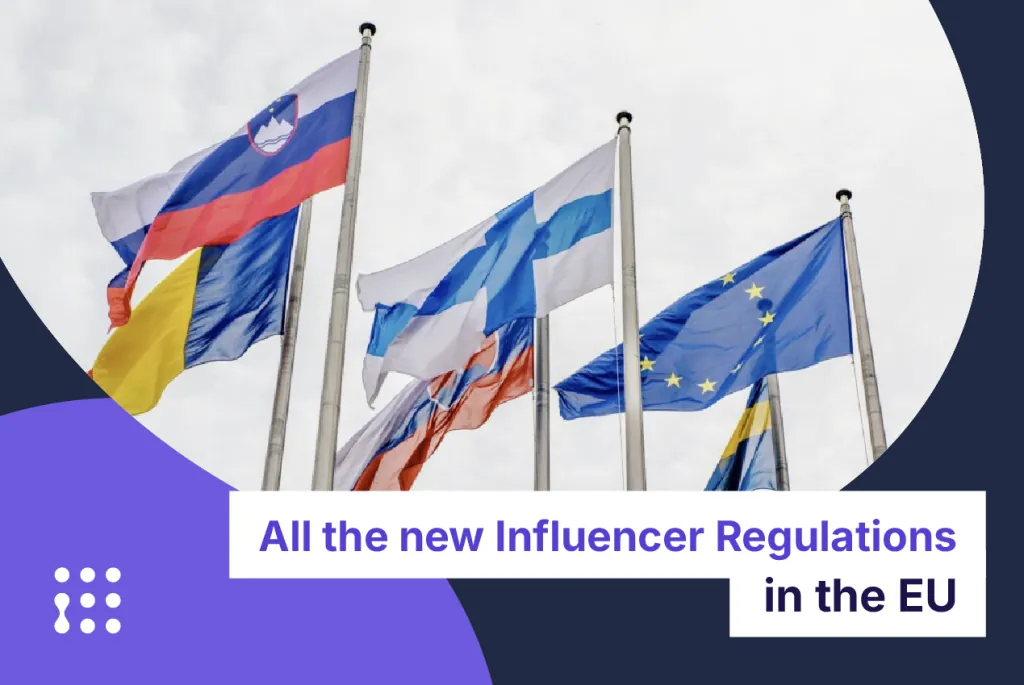
Influencer marketing in the European Union can be problematic: while having a unified market for goods and services the regulations and responsibilities around the promotion of such goods and services can vary drastically from country to country.
Three main actors are involved in shaping the regulations around influencers in the 27 countries of the Union: the European Commission and Parliament with their Directives (especially the Digital Service Act and the General Data Protection Regulation), the European Advertising Standard Alliance (EASA) which is a self-governing organization (SRO) that coordinates with national homologs SROs to create a common framework for advertising and local governments that can go above and beyond the European regulations.
This article is part of our series on influencer marketing regulations. You can find our other here:
- The international guide to influencer marketing regulations
- Influencer regulations in Asia
- Influencer regulation in English-speaking countries
- Influencer regulation in Latin America
Digital Service Act (DSA) & influencers
Entered into force on the 16 of November 2022, the Digital Service Act (DSA) has the goal to contain the spread of harmful content and create an environment that is faster to react to illegal content. In doing so, the DSA incidentally tackle influencers and their content.
By connecting the definition of “illegal content” with the national law of member states (“any information or activity, including the sale of products or provision of services which is not in compliance with Union law or the law of a Member State, irrespective of the precise subject matter or nature of that law”), the DSA expands already existing regulations applicable to advertising to influencer marketing.
Based on this interpretation of the DSA that most countries without a regulation that specifically targets influencers connect them to other forms of marketing and include them in their existing regulations.
GDPR compliance in influencer marketing
General Data Protection Regulation (GDPR) is the main legal framework that rules the collection and use of data of EU citizens. Implemented in 2018 it aims to protect personal data and guarantee the right to be forgotten to any individual that had previously provided its personal data. Anyone that intends to engage in influencer marketing within the EU should make themselves very familiar with the provisions included in the GDPR since fines to breach it can reach 20 million euros or 4% of a company’s international turnover.
Luckily for you, if you are engaging in influencer marketing is quite easy to comply with GDPR’s requirements since differently than with other ways of marketing you are not collecting influencers’ or customers’ personal data.
If you plan to collect influencers’ or (potential) customers’ data you need to explicitly inform the interested parties of it. Furthermore, you need to be able to scrap records about any individual at that individual’s will. Any use of data collected this way should be done only after anonymization if not otherwise directly agreed with the involved subjects.
What are EASA’s best practices on influencer marketing?
EASA is a self-governing agency that connects all the national advertising agencies active in the EU and tries to coordinate them in adopting similar regulations to create a homogeneous environment when it comes to advertising. EASA does not have legislative powers and neither the national agencies do but they often impose fines and punishments for regulations transgressions.
In May 2022 EASA published a new iteration of its best practices for influencer marketing, in this version the agency calls for the obligation to disclose commercial partnerships and enhanced collaboration for brands in order to forge a more ethical ecosystem where customers are safe and protected.
EASA’s best practices on influencer marketing are the bedrock foundation for doing influencer marketing in the EU. While some countries may have more stringent or more lax regulations, adhering to EASA’s will make you compliant in most cases.
While not constituting law, EASA’s best practices aim to be the stepping stone to spark national self-regulatory organizations (SROs) into adopting a cohesive and coherent regulatory framework.
To help creators and marketers EASA prepared an online tool called DiscloseMe, thanks to this tool is possible to look know the regulations of every country in the European Union.
National regulations
Austria
In Austria, the Media Act, and the Code of Ethics created by the Austrian Advertising Council establish that is required to disclose clearly when content is an advertisement.
Belgium
In Belgium, influencers are considered on the same level as media service providers, and like them, they need to make commercial communications recognizable. Concurrently who is paying the influencer need to make sure that there is a clear disclosure.
Bulgaria
The Bulgarian National Council for Self-Regulation recommends for any sponsorship be disclosed through the use of dedicated hashtags and in a clear and immediate way.
Croatia
Croatia does not have specific regulations for influencers but their activities fall under the category of promotional activities. Like other promotional activities sponsored posts need to be clearly identified as such, with the possibility of fines for both influencers and brands violating the Media Act.
Cyprus
Considering the small population of the country influencer regulation is not at the forefront of the topics debated.
Czechia
Czechia had to deal with many influencers promoting tobacco and alcohol products and without any dedicated legislation the pushback has been light and ineffective. The Platform of Professional Communication, a self-regulatory body that covers influencers, agencies, and brands has created a Code of Conduct with best practices. The Code invites the influences to mark the sponsored posts as such, not lie or conceal information about their experience with products and services and respect the laws around regulated products like alcohol, tobacco, and gambling which should not be advertised by anyone with an audience composed for more than 25% by underage people.
Denmark
Hidden advertisement is illegal in Denmark and this translates to influencers’ promotions as well as de-facto making it mandatory for influencers to disclose their partnership and be upfront with their connection to the brands. Recently the Danish Veterinary and Food Administration passed new rules especially aimed at tackling the promotion of foods, prohibiting exaggerated claims and anecdotal evidence for health benefits that could mislead customers.
Estonia
The Consumer Protection and Technical Regulatory Authority of Estonia established that influencers’ promotions on social media need to be clearly marked as such. Concurrently alcohol and tobacco promotions are not allowed on the personal account of an influencer.
Finland
The Finnish Competition and Consumer Authority composed guidelines for influencer marketing on social media in 2019. The guidelines promote the disclosure of advertisement content and paint both the influencer and the sponsor as responsible for the respect of the rules.
France
In March 2023 France passed new regulations for influencer marketing. Under this framework, influencers can incur in high fines (up to €300,000) and even jail time if fail to properly disclose sponsored content. Striving to also address the harmful impact that edited photos have on people’s self-esteem and mental health the bill includes an obligation of disclosure also for those instances.
Germany
The case of influencer promotion in Germany has been at the center of a few court decisions that created and shaped how influencers should behave. While was rapidly clear that any paid promotion, not immediately recognizable as such, should be labeled with proper hashtags in order to inform the potential customers of the sponsored nature of the deal, German courts had variable takes in regard to unpaid promotions. If the influencer buys the product themselves or receives it for free should they still disclose it as a partnership? Ultimately the court decided that the only way to not have to disclose is if is proven that the brand mentioned in the post had no influence in the judgment expressed. Since is easier said than done, the safest approach is to disclose it as sponsorship even when there is no monetary transaction between the influencer and the brand.
Greece
Greek influencers don’t need to comply with any specific law but they are bound to the Hellenic Advertising Communications Code that imposes the disclosure of promotional material making the marking of sponsored content as such mandatory.
Hungary
Hungary’s Competition Authority requires influencers to disclose their sponsorships and keeps both the influencer and the brand liable in case of violations.
Ireland
Ireland influencers are self-regulated under the Advertising Standard Authority for Ireland (ASAI) which requires commercial content to be tagged as such. In the past, the ASAI publicly shamed those influencers who didn’t comply with the practice.
Italy
The Istituto di Autodisciplina Publicitaria (IAP) is the self-regulating organ responsible for regulating marketing in Italy. In 2019 they included the “Digital Chart”, a collection of best practices before only recommended, in their regulations making it mandatory for influencers to disclose sponsored content through proper use of hashtags.
Latvia
Latvian authorities require sponsorships to be disclosed via text or orally.
Lithuania
Influencer practices aren’t the most pressing issue faced by Lithuania, considering that the country in 2020 only had 300 people that would have qualified for the title. But nonetheless, the self-regulating marketing organization created guidelines that encourage influencers to label their sponsored posts with the hashtags #ad or #reklama.
Luxembourg
Luxembourg has not instituted any special rule for influencers, but any influencer inside the little principate needs to follow the guidelines of the Autorité Luxembourgeoise Indépendante de l’Audiovisuel (ALIA)
Malta
No specific regulation has been established around influencers in Malta.
Netherlands
Dutch regulators established that is mandatory for any content creator with over 500,000 subscribers to register with the Media Authority, join the Dutch Advertising Code Authority, and clearly state when content is sponsored by the use of dedicated hashtags. In case of non-compliance Dutch authorities could impose fines of up to €225,000.
Poland
The Office of Polish Competition and Consumer Protection instituted a series of guidelines after a concerning investigation into social media advertising. Currently, content should be tagged and clearly understandable to be sponsored content. Violation can incur in fines of up to 10% of the influencer or brand turnover.
Portugal
No specific regulations have been introduced by Portuguese authorities regarding influencer marketing. Sponsored content falls under the category of commercial communication and requires to be disclosed as such. Therefore the use of hashtags to indicate a partnership is necessary when operating in Portugal.
Romania
Romania does not have special regulations for influencers when it comes to sponsorships.
Slovakia
The Slovakian self-regulating agency issued a Code of influencer marketing requiring that sponsorships are fully disclosed and forbidding the use of fake reviews.

Slovenia
Influencers in Slovenia are not considered media and because of this technicality, they are unaffected by the Mass Media Act and any existing advertisement regulation.
Spain
The Asociación para la Autorregulación de la Comunicación Comercial (Autocontrol) establishes what constitutes a commercial post and how it needs to be labeled in Spain. Whenever a post is aimed at promoting products or services, is the result of financial remuneration, or is subject to validation before publication it falls under the Code of Conducts regulation. Autocontrol establishes that posts need to be marked as commercial by explicitly stating it and when possible by also using the features built into the social networks to highlight such cases.
Sweden
Swedish regulators, and courts, have established that any kind of sponsored content needs to be marked as such, clearly indicating if the influencer received compensation for the post.

Work with CreatorDB
Put this into
practice.
Talk to our Asia agency team about applying these ideas to a real creator campaign — or open the CreatorDB app and start building your shortlist now.
Frequently Asked Questions.
What are the main regulatory bodies shaping influencer marketing rules in the EU?
Three key actors set EU influencer regulations: the European Commission and Parliament issue overarching directives like the Digital Service Act and GDPR; the European Advertising Standard Alliance (EASA) coordinates self-regulatory standards across national advertising bodies; and individual member states impose local laws that can exceed EU minimums. This three-tier structure means compliance requirements vary by country, even within the unified EU market.
How does the Digital Service Act affect influencer marketing in Europe?
The Digital Service Act, which entered force November 16, 2022, targets illegal content and harmful material across digital platforms. It defines illegal content as anything non-compliant with EU or member-state law, which expands existing advertising regulations to cover influencer marketing. Most EU countries without specific influencer rules now apply their general marketing regulations to influencer content under this framework.
What GDPR requirements apply when running influencer campaigns in the EU?
GDPR's core requirement for influencer marketing is transparency: you must explicitly inform any individual whose data you collect and respect their right to deletion on request. You don't collect influencer or customer personal data in standard campaigns, so basic compliance is straightforward. However, violations carry severe penalties—up to 20 million euros or 4% of global turnover—so familiarize yourself fully with GDPR provisions before launching.
What does EASA require influencers to disclose about brand partnerships?
EASA's May 2022 best practices mandate full disclosure of commercial partnerships between creators and brands. While EASA lacks legislative power, its framework guides national self-regulatory organizations and often influences enforcement. Adhering to EASA standards ensures compliance in most EU markets, even though individual countries may impose stricter or more lenient rules on top.
Is there a tool to check influencer marketing regulations by EU country?
Yes. EASA created DiscloseMe, an online tool that lets you look up specific influencer marketing regulations for every EU member state. It simplifies navigating the fragmented regulatory landscape across the 27 countries, helping creators and brands stay compliant with both EASA standards and national-level requirements.