4Ms Model for Influencer Marketing Strategy
Master the 4Ms model to structure influencer campaigns that drive real results. Build effective strategies using this proven framework for 2026.
Get familiar with the 4Ms model for influencer marketing and ace your next campaign.
If you dabble in marketing, you are probably familiar with the 4 P’s, one of the pillars of marketing theory, which see Product, Price, Place, and Promotion as fundamental aspects for any marketer that wants to achieve their objectives.
While this model was and still is a fundamental base when discussing how to market a product, the emergence of new channels to reach clients has pushed for new models. In 2004 Sid Peimer proposed the “Internet Mix” composed of Sell, Tell & Dwell as the central pillar to succeed in online marketing.
The “Internet Mix” is, under many aspects, still a valid model and can be a perfect guide to understanding the needs of a digital marketing campaign and if your planning is going in the right direction.
With word of mouth and social proof becoming a more and more prominent aspect of digital marketing, especially influencer marketing, a new model came to light to frame how influencer marketing campaigns should be organized and their life cycle: the 4Ms model.
Thanks to this model, you can identify the core tenants of an influencer marketing campaign and easily understand your positioning.
Where does the 4Ms model come from?
Danny Brown and Sam Fiorella introduced the 4Ms model in their 2013 book “Influencer Marketing: How to Create, Manage and Measure Brand Influencers in Social Media Marketing.” In it, they introduce the idea that influencer marketing, like other forms of marketing, needs to include goals and metrics to be effective. Brown and Fiorella suggest using the 4Ms model to create successful influencer marketing campaigns based on your goals and metrics.
What are the 4Ms?
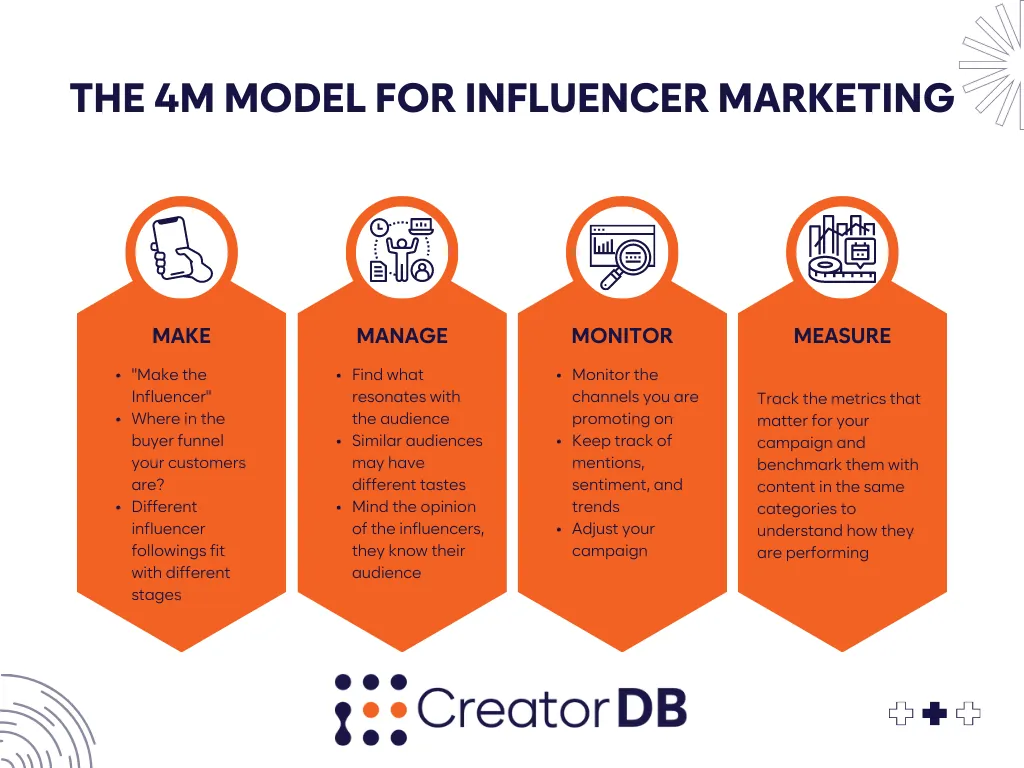
The 4Ms are: Make, Manage, Monitor, and Measure, and they are used to create and follow an influencer marketing campaign from start to finish. The 4Ms are especially important not to get distracted by the many vanity metrics and secondary achievements that often become the main point of influencer marketing campaigns while focusing on the real benefit of influencer marketing:
Make
“Make the influencer” by understanding at which stage of the customer journey your customers are. Each different position in the funnel would require a different approach to successfully being pushed further down. Therefore knowing which kind of audience you are targeting is extremely important to make the correct decision about which influencers to collaborate with. Identifying the audience of any influencer and understanding how they fit in your sales funnel is the first step to success.
Manage
Manage is the more experimental moment of any campaign. Now that you have the right influencers for your campaign, it is time to see how their audience resonates with a different kind of content. While other influencers may target a similar audience, there can be significant differences in what their audiences enjoy. Considering that the influencer is the one that best knows its audience preferences is essential to keep their ideas in mind and give them at least a fair shot.
Want to learn more about how different content can lead to different outcomes? Check our Wargaming case study!
Monitor
Once the campaign is up and running is vital to monitor it actively. Social webs are not static, and by offering them a stimulus, the marketing campaign, they will answer to it, sometimes in unpredictable ways. By keeping track of mentions, sentiment, and trends around the sponsored content, you can individuate other influencers that will benefit your campaign and how external factors are aiding or disrupting your messaging. By proactively monitoring, you can rapidly adjust your campaign and react to changes in the circumstances that could disrupt your goals.
Measure
As for every marketing campaign, ROI is the most critical metric. Whatever your final goal is, you should have had it very clear since the beginning and have divided it by measurable metrics. Using content categories benchmarks to establish goals and thresholds. Controlling various measurements will make it easy to spot the influencers that overperformed, who underperformed, what kind of content was more effective in achieving your objectives, and much more.
Conclusion
Too often, companies and marketing departments decide to adventure into the world of influencer marketing because they expect it to be the next big thing and to bring results anyway. But like every other form of marketing, influencer marketing needs to have a solid backbone to work, a backbone that will sustain your current strategy and help you improve upon what you have already done, and boost your growth in the future. The 4Ms model provides you with all the tools you need to present and future success.
If you are looking for the perfect way to handle your influencer marketing campaigns, look no further than CreatorDB.
CreatorDB’s platforms let you access all you need to achieve your influencer marketing goals in one place: from influencers discovery to performance tracking to market analysis.
CreatorDB also shows the audience’s sentiment about each influencer’s content and lets you easily differentiate between organic and sponsored content. If you want to succeed in influencer marketing, book your consultation today.
Work with CreatorDB
Put this into
practice.
Talk to our Asia agency team about applying these ideas to a real creator campaign — or open the CreatorDB app and start building your shortlist now.
Frequently Asked Questions.
What is the 4Ms model in influencer marketing?
The 4Ms model—Make, Manage, Monitor, and Measure—provides a framework to structure influencer campaigns from start to finish. Make involves identifying the right influencers based on audience fit and customer journey stage. Manage is the experimental phase where you test how audiences respond to different content. Monitor tracks campaign performance in real time, allowing you to spot new opportunities and adjust for external factors. Measure focuses on ROI and whether you've hit predefined goals.
How do you choose influencers using the Make phase?
In the Make phase, identify where your target customers sit in the sales funnel, then shortlist influencers whose audiences match that stage. Different funnel positions require different messaging—awareness-stage audiences need broad reach, while conversion-stage audiences need trust-building proof. Understanding each influencer's audience demographics and how they align with your funnel position is the critical first step. The influencer's audience must resonate with your product and buying stage, not just match your target market size.
Why is monitoring a live campaign important in influencer marketing?
Social platforms generate unpredictable responses to sponsored content. Active monitoring tracks mentions, sentiment, and trends around your campaign, revealing unexpected opportunities and external disruptions to your messaging in real time. Proactive monitoring lets you adjust strategy mid-campaign, identify complementary influencers to amplify results, and react to shifts in audience behavior before they derail your goals. This agility separates campaigns that hit targets from those that miss.
What metrics should you measure to evaluate influencer campaign success?
ROI is the core metric, but only if you defined specific, measurable goals at the start. Use content category benchmarks to set realistic thresholds and track performance against them. Measure which influencers overperformed or underperformed relative to those benchmarks, what content formats drove the best results, and how well you hit your original objective. Granular measurement reveals which elements of the campaign worked, not just whether it succeeded overall.
How does the 4Ms model differ from traditional marketing frameworks like the 4Ps?
The 4Ps (Product, Price, Place, Promotion) frame product marketing broadly. The 4Ms model is built specifically for influencer marketing and social channels, where word-of-mouth and social proof dominate. The 4Ms emphasize audience fit, content experimentation, real-time monitoring, and measurable outcomes—addressing the unique dynamics of creator partnerships. It replaces vanity metrics (follower counts, likes) with business outcomes tied to customer journey stage and campaign ROI.