United States
Jonathan Haidt is a social psychologist and professor at NYU Stern School of Business whose public intellectual work has made him one of the more consequential voices in contemporary debates about technology, adolescence, and mental health.
Total Followers +1.9%
907K
Across Instagram
Primary Platform
YouTube
907K followers · 100% of audience
Engagement
2.8%
vs. 1.5% category median
Sponsorship Tier
Mid
Est. $14K–$32K / IG post
NYU selected Haidt as its all-university commencement speaker, citing his work as "a leading voice on technology and human flourishing." The Anxious Generation had been a NYT bestseller for 104 weeks at the time of the announcement.
Introduced by MIT President Sally Kornbluth, Haidt warned of "dramatic global decay in cognition, attention spans, and civic life" driven by smartphones and short-form video, and urged policy curbs on tech use.
Co-written with science journalist Catherine Price and illustrated by Cynthia Yuan Cheng, the middle-grade guide was published December 30, 2025 and quickly became a #1 NYT bestseller.
Yale President Maurie McInnis hosted Haidt for a sold-out lecture, "How to Be a Student in an Era of Anxiety and Political Polarization," at Battell Chapel.
Both honors reflect Haidt's continued prominence as a public intellectual and advocate for childhood phone-free norms and civil discourse.
| Platform | Followers | 30d Growth | Engagement | Posts / wk | Last upload |
|---|---|---|---|---|---|
| 907,131 | +18K | 2.8% | 4.7 | 3 days ago |
| Window | Combined | |||
|---|---|---|---|---|
| Last 7 days | +2K +0.3% | +0 +0.0% | +0 +0.0% | +2K |
| Last 30 days | +18K +1.9% | +0 +0.0% | +0 +0.0% | +18K |
| Last 90 days | +94K +10.3% | +0 +0.0% | +0 +0.0% | +94K |
| Last 365 days | +94K +10.3% | +0 +0.0% | +0 +0.0% | +94K |
Daily follower snapshots from CreatorDB's longitudinal index.
Jonathan Haidt is a social psychologist and professor at NYU Stern School of Business whose public intellectual work has made him one of the more consequential voices in contemporary debates about technology, adolescence, and mental health. His earlier books, including 'The Righteous Mind' and 'The Coddling of the American Mind' (co-authored with Greg Lukianoff), built a broad cross-partisan readership interested in moral psychology and campus culture. His 2024 book 'The Anxious Generation' — a research-driven argument that smartphone-based childhood is driving a youth mental health crisis — became a #1 New York Times bestseller and expanded his platform considerably, translating academic research into an active advocacy movement centered on phone-free schools and revised childhood norms.
On Instagram, Haidt functions less as a traditional influencer and more as a movement organizer and public educator, using the platform to amplify policy developments, share data visualizations, and spotlight international examples — particularly from Scandinavian countries that have moved toward school phone bans. His audience skews female and spans a wide age band, with a substantial cohort of parents and educators alongside younger adults processing their own digital upbringings. The engagement rate runs meaningfully above category median, reflecting a highly activated following rather than passive viewership. His brand positioning is naturally aligned with education-adjacent organizations, parenting platforms, mental health initiatives, and institutional partners rather than consumer product sponsors — a profile that should continue to strengthen as phone-free school legislation gains traction globally.
Jonathanhaidt reaches an audience concentrated in United States primarily through YouTube, and is best activated via Instagram Reels and Stories. As an education creator they map naturally to brands targeting that space. With no brand deals logged yet, they read as an available, category-aligned partner for advertisers building early presence in the space. Engagement on YouTube runs around 2.8%, which points to an audience better suited to category-relevant, mid-funnel campaigns than to pure-reach buys. Their YouTube-first format lends itself to integrations that sit inside the creator's usual content rather than running as standalone ads. Because the audience follows education content rather than arriving through untargeted reach, sponsorships that match the channel's subject matter tend to convert more efficiently than broad placements. A consistent, on-topic posting focus gives sponsors a predictable, brand-safe environment, lowering placement risk compared with broad, general-interest channels. Campaigns here are best measured on qualified engagement and consideration within the niche rather than on raw impression volume. For United States-focused brands in education and related categories, Jonathanhaidt offers a defined, creative-fit audience rather than broad, low-intent impressions.
Benchmark estimates for a creator at Jonathanhaidt's tier (Mid, 907K combined followers, United States). Pulled from CreatorDB's category benchmarks.
The CreatorDB Agency runs end-to-end influencer campaigns globally — shortlisting, outreach, contracting, and performance reporting. Talk to our team about building a campaign around creators in this niche.
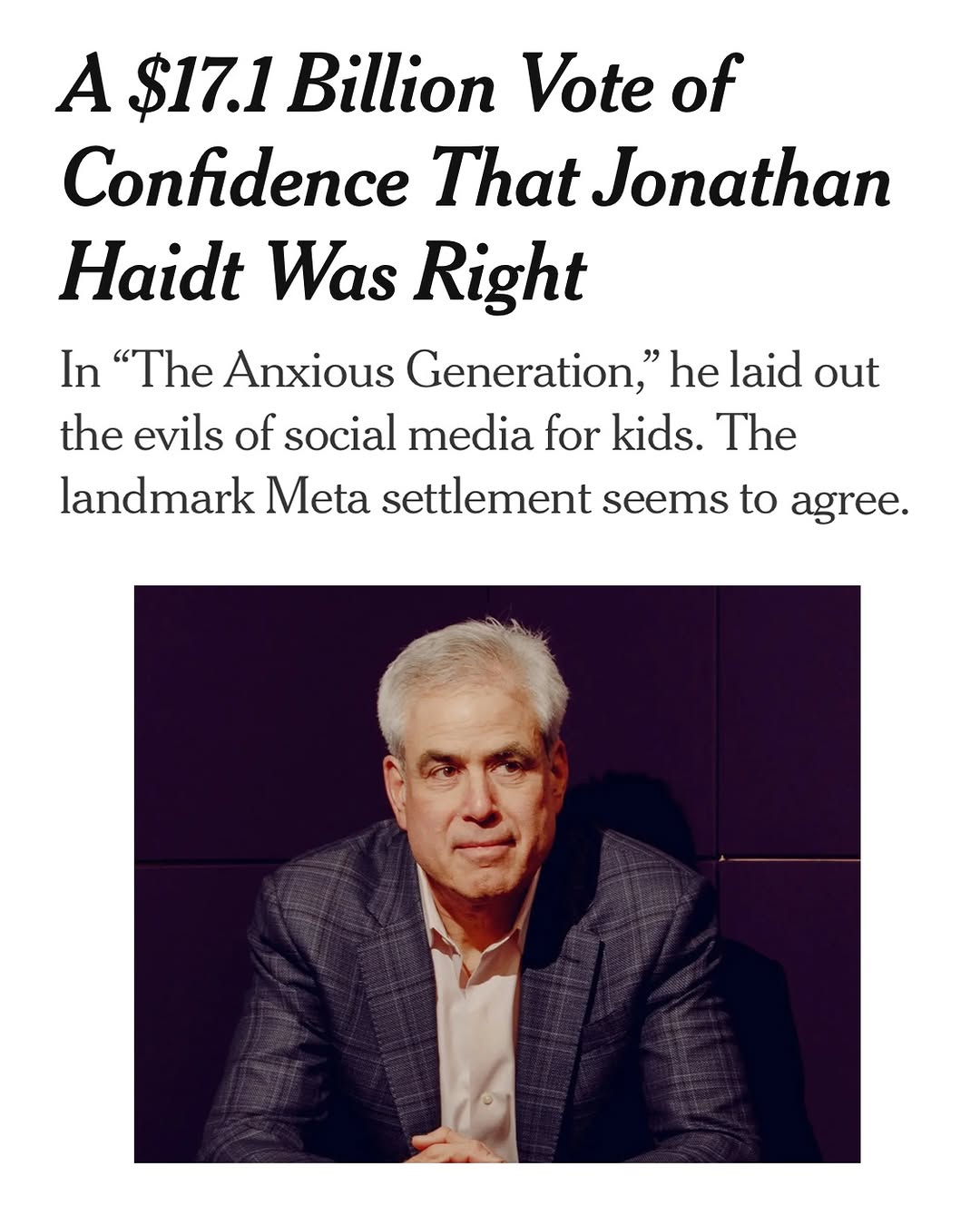
The Anxious Generation argues that the rapid adoption of smartphones and social media during the early 2010s triggered a worldwide mental health crisis among adolescents, particularly girls. Haidt traces what he calls "the great rewiring of childhood," in which phone-based experiences replaced free play and face-to-face socializing. The book debuted as a number-one New York Times bestseller and ignited policy debates about minimum age limits on social media platforms.
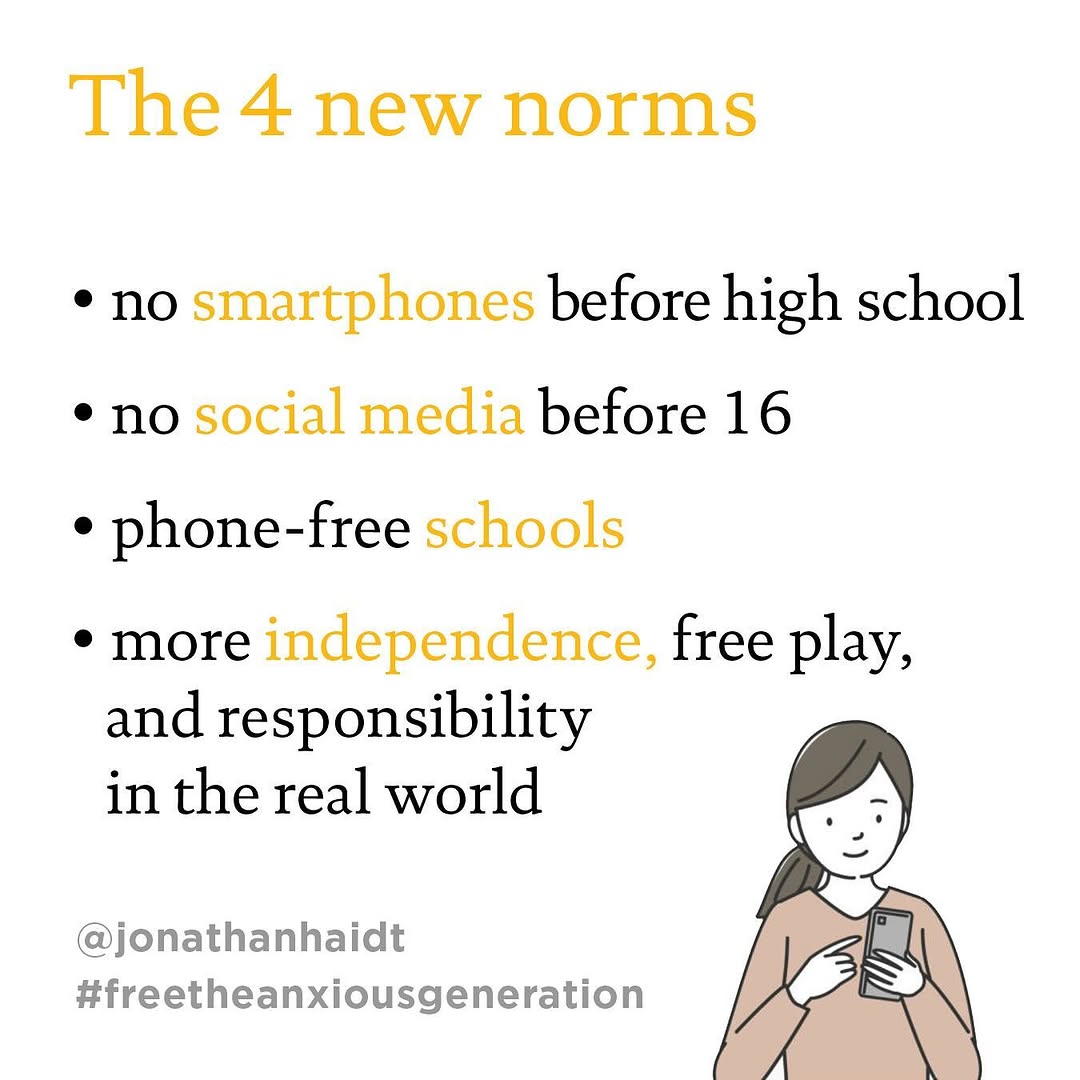
Haidt's four norms are: no smartphones before high school, no social media before age 16, phone-free schools during the school day, and more unsupervised free play and independence for children. He frames these not as individual parenting choices but as collective commitments that only work when whole communities adopt them together. The hashtag #thefournorms throughout his posts refers directly to this framework.
Yes — phone-free schools is one of the central policies Haidt campaigns for, and he uses the hashtag #phonefreeschools to amplify schools and districts that have already adopted the policy. He argues that removing phones from the school day restores sustained attention, reduces social comparison, and gives adolescents a meaningful break from social media dynamics during a developmentally vulnerable period. He points to countries like Norway and Sweden as proof that the policy works at a national scale.
Haidt tags Snapchat as part of his broader critique of social media platforms that market to adolescents, arguing that features like ephemeral messaging, social feeds, and algorithmic recommendations are particularly harmful to girls between the ages of roughly 11 and 16. His advocacy calls on these companies — including Snapchat, Instagram, and TikTok — to raise their effective age of access and implement meaningful safety measures rather than relying on easily bypassed age gates.
Jonathan Haidt is a professor of ethical leadership at the Stern School of Business at New York University, which he references directly in his social media bio. Before joining NYU Stern, he spent many years as a psychology professor at the University of Virginia. His academic home gives him a research platform that underpins the data and citations he regularly shares with his public audience.
Norway and Sweden have moved more aggressively than most countries to restrict smartphones in schools, making them real-world case studies Haidt cites to show the policy is scalable and politically achievable. Both countries appear by name in his regular hashtag set specifically because he uses them as evidence for skeptics who argue phone-free school policies are impractical. Pointing to Scandinavian national-level decisions lets him reframe the debate from "should we" to "how do we."
Safetyism is a term Haidt developed with co-author Greg Lukianoff to describe the pattern of protecting children from every conceivable risk — including small, unlikely, or character-building ones — in ways that ultimately produce more fragile, anxious adults. He argues that Western parents and institutions became overprotective in the physical world at precisely the moment they were underprotective in the digital world, creating a perfect storm for the mental health decline he documents in his research. The hashtag #safetyism appears throughout his content as shorthand for this critique.
Yes — Haidt co-authored The Coddling of the American Mind (2018) with First Amendment lawyer Greg Lukianoff. The book argued that universities were teaching students three "great untruths" — that young people are fragile, that emotions reliably reflect reality, and that the world is a battle between good and evil — in ways that undermined resilience and free inquiry. It is widely seen as the intellectual precursor to The Anxious Generation, extending the fragility argument into the specific role of social media.
AnxiousGeneration.com is the companion website and movement hub Haidt built around his book, designed to help parents, educators, and policymakers take concrete steps toward phone-free schools and delayed smartphone ownership. The site functions as a collective action platform, reflecting Haidt's argument that individual family decisions are far less effective than community-wide norms. He references it directly in his Instagram bio and drives traffic there through his ongoing posts and hashtag campaigns.
Haidt's following is unusually large for a university professor, built on the back of a mainstream bestseller and a grassroots movement — phone-free schools — that resonated strongly with parents, teachers, and school administrators already worried about teen mental health. His engagement runs well above the typical benchmark for creator accounts in his reach tier, which analysts generally attribute to a highly motivated audience sharing his content as a form of advocacy rather than passive scrolling. The timing also helped: public concern about social media and adolescents reached a peak as The Anxious Generation launched.
Stats (followers, engagement, audience demographics, growth) are pulled live from the CreatorDB API covering YouTube, Instagram and TikTok. Bio and FAQ content is AI-assisted; news items are sourced from cited public press at generation time. Read the full methodology →
If you'd like to update, correct, or remove this profile, get in touch and we'll handle it within 5 business days. We don't publish private data — every stat shown comes from your public platform profiles.
@jonathanhaidt · YouTube
+0 new followers
Preparing fresh data…
This usually takes 15–25 seconds.